
EU Regulatory Update
2026 March 27
A New Reality for the Common Charger
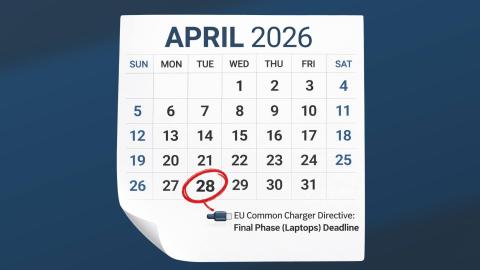
The European Union’s (EU) universal charging mandate is no longer a looming regulation; it is the daily reality of the electronics market. While smartphones and small electronics have been required to use USB-C for over a year, the industry is now racing toward the final major milestone: By April 28, 2026, all new laptops sold in the EU must officially support charging via USB-C.
This final phase of Directive (EU) 2022/2380 (often called the "Common Charger Directive") represents a significant technical shift. By bringing high-power laptops into the fold, the EU is completing its mission to create a truly interoperable ecosystem, reducing an estimated 11,000 tonnes of annual e-waste and saving consumers an estimated €250 million every year. [1]
Why USB-C?
The EU selected USB-C as the common standard because of its unique ability to scale across the entire electronics spectrum:
- Widespread Adoption: It is already the industry standard for modern data and power.
- Versatility: A single cable handles high-speed data, video output, and power.
- Scalability: With USB Power Delivery (USB PD), the standard scales from low-power earbuds up to high-performance laptops requiring up to 240W.
Compliance Requirements for Manufacturers
For any device sold in the EU today—and for all laptops by the April 2026 deadline—manufacturers must meet three core requirements:
- Mandatory USB-C Ports: All wired charging must happen via a USB-C receptacle.
- Harmonized Fast Charging: Any device charging at more than 15W must support the USB PD standard to ensure it works with any compliant charger.
- Clear Labeling: Packaging must display specific markings indicating charging performance and whether a power adapter is included in the box.
The Hidden Challenge: Testing and Validation
While consumers benefit from the convenience of a single cable, manufacturers face the technical burden of proving compliance. Every new device sold in Europe must demonstrate that its USB-C implementation is robust, interoperable, and perfectly aligned with USB PD standards.
This is particularly complex for laptops, where power negotiation is far more sophisticated than for a smartphone. Companies need tools to simulate real-world "edge cases," such as mismatched chargers, sudden disconnects, and varying power roles.
Where Acroname Fits In
Acroname provides the specialized infrastructure required for this new era of compliance. Our USB-C hubs and switches are designed to handle the rigors of EU-standard testing:
- Programmable USB PD testing: Verify power negotiation and charging behavior with real-time message decoding for troubleshooting.
- Powerful APIs: Seamlessly integrate into automated Python, C++, or LabVIEW test environments.
- Automated Port Control: Easily simulate a variety of device/host setups and failure modes.
- Industrial-grade Reliability: Consistent results from the R&D lab to the factory floor.
For manufacturers navigating the final countdown to the April 28, 2026 laptop deadline, Acroname hubs provide a ready-made path to verified compliance.
Closing Thought
The "Common Charger" era is here. As laptops join the mandate this April, the industry is finally achieving a truly universal ecosystem. At Acroname, we are proud to provide the tools that make this transition seamless.
Is your hardware ready for the 2026 deadline? Contact Acroname to see how our USB-C test tools can help.
References
[1] Deal on common charger: reducing hassle for consumers and curbing e-waste
Add New Comment