
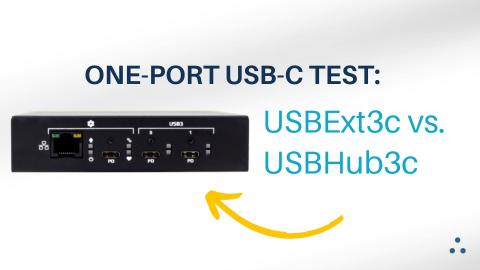
Not every USB-C test system needs multiple managed ports. Many manufacturing, validation and regression setups just need a single controlled USB-C link: one host, one device, with control over attach state, link behavior, power and recovery. USBHub3c is a good choice because it gives engineers direct control over USB-C port behavior. But if the setup only needs one host-side and one device-side test port, a single USBExt3c is worth considering.
Acroname designed USBExt3c mainly as a USB and power extender plus test-friendly port-level features. But in standalone mode, it acts as a managed one-port USB-C hub, providing a single host-to-device link. One of its two full-featured USB-C ports is assigned upstream to the host and the other downstream to the device; each port can take either role. USBExt3c provides many of the same port-level controls as USBHub3c, minus the external load feature.
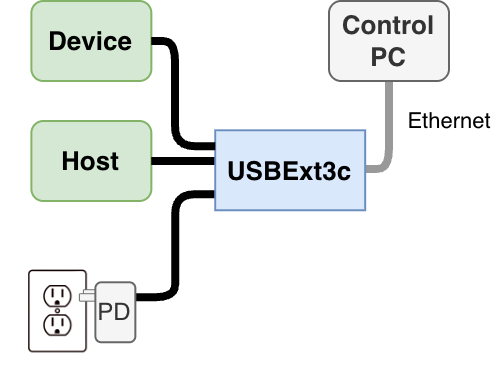
USBExt3c and USBHub3c overlap in many of the features that matter for one-link USB-C testing.
Both support:
- BrainStem API and HubTool
- software-controlled data and power role assignment
- port enable and disable
- link-speed control
- separate control of USB 2 and SuperSpeed paths
- automated hot-plug cycling and cable flip
- with add-on feature licenses: USB-PD logging, PDO editing, VDM workflows, RS-232 control and programmable power-related test functions
The main differences are in power, control and port count:
USBExt3c
- dedicated Ethernet port for management via HubTool, BrainStem API, REST interface and built-in web interface
- Ethernet control allows the control PC to be placed away from the host and DUT
- can be powered via PoE++ on the extension port
USBHub3c
- more managed ports
- external VBUS load path for load testing
- DC input for higher-power applications
When USBExt3c makes sense
If the job needs a single controlled USB-C link, USBExt3c is a good fit. That is especially true if Ethernet control is useful, when the control PC needs to be located away from the test fixture, or when the fixture can benefit from PoE.
When you want a full USBExt3c pair
Use a USBExt3c pair when the host and device need to be physically separated. In extender mode, the two units provide four assignable ports in total, typically used as one upstream-facing host port and three downstream-facing device ports: one on the host side of the extension and two on the remote extender.
When USBHub3c is still the better fit
USBHub3c remains the better fit when the setup needs, or is likely to grow into, more managed ports, external VBUS load testing, or DC input for higher-power applications. But if the work is really a one-link problem, a single USBExt3c is often enough.
USBExt3c was designed mainly as an extender, but in standalone mode it is also a managed one-port USB-C hub with many of the same test-oriented controls as USBHub3c. For one-link manufacturing, validation and regression setups, that can make it a simpler fit than a larger multi-port hub.
Add New Comment